Quick answer
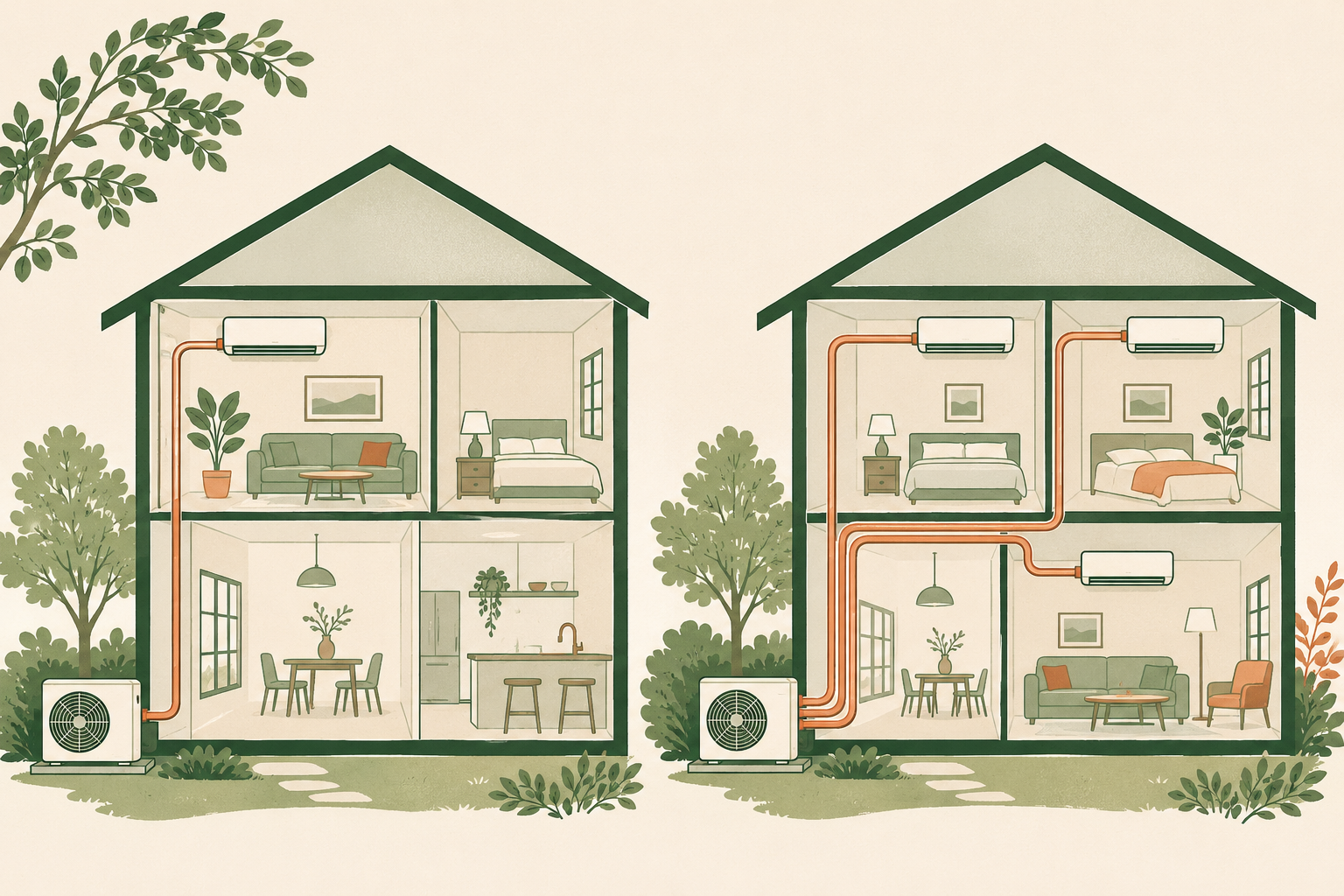
A single-zone system pairs one indoor unit with one dedicated outdoor unit (1-to-1). A multi-zone system connects two to five indoor units to a single, larger outdoor condenser.
While multi-zone systems save exterior ground space, two separate single-zone systems can cost about the same to install, may offer higher rated efficiency depending on matched models, can modulate to lower minimum outputs, avoid mode conflicts, and keep one room running if the other outdoor unit fails. Compare the specific equipment and quotes before choosing.
Side-by-side engineering comparison
| Factor | Multiple single-zone systems (1-to-1) | One multi-zone system (Multi-head) |
|---|---|---|
| Typical installed cost (2 zones) | Quote-dependent; compare itemized proposals | Quote-dependent; compare itemized proposals |
| Efficiency ratings | Model-specific; compare SEER2 for the matched systems | Model-specific; verify the matched combination |
| Minimum modulation (Turndown) | Model-specific minimum output; verify the submittal data. | Model-specific minimum output; verify the submittal data. |
| Simultaneous heating/cooling | Full independence: One room can heat while another cools. | Not possible: All heads must run in the same mode (heat or cool). |
| Redundancy (Equipment failure) | Complete: If one outdoor unit fails, the other keeps running. | Single point of failure: If the compressor fails, all rooms lose comfort. |
| Exterior footprint | Requires space and mounting for multiple outdoor units. | Requires only one outdoor pad or bracket. |
| Refrigerant line routing | Usually short, direct back-to-back runs through the exterior wall. | Longer runs, branching boxes, attic/crawlspace penetrations, and line covers. |
The simultaneous heating/cooling trap
A common homeowner surprise with residential multi-zone systems is mode conflict. A standard multi-zone heat pump has a single reversing valve in the outdoor condenser. As a result, the entire system must be in either heating mode or cooling mode.
If someone sets the living room unit to “Cool” on a sunny spring afternoon while someone else sets a north-facing bedroom to “Heat,” the system will trigger an error code or lock out the second unit until the first unit satisfies. Many conventional residential multi-zone heat pumps cannot heat and cool different indoor units simultaneously. Heat-recovery systems may support that function; verify the exact equipment documentation.
Turndown ratio and seasonal efficiency
Turndown depends on the specific compressor and control logic. In a multi-zone system, a large outdoor unit serving several lightly loaded rooms may have to operate at a minimum output that exceeds what one room needs. Ask for the minimum capacity of the matched combination; the consequences for cycling and efficiency depend on that data.
A single-zone unit sized to its room can run at lower relative output for that room, but its minimum output is still model-specific and should be checked against the submittal data.
Line-set routing and system redundancy
With a multi-zone system, every indoor head must connect via a pair of copper refrigerant pipes, drain tube, and electrical communication wire back to the single outdoor unit. In a two-story home, running line sets from distant upstairs bedrooms to a ground-level condenser often requires long runs across exterior siding inside decorative plastic trunking (line-hide), or difficult routing through attics and closets.
Two separate single-zone units often allow direct, clean “back-to-back” installations through the exterior wall directly down to individual outdoor brackets, minimizing line length, refrigerant charge, and installation labor.
Decision framework: Which should you choose?
- Choose single-zone units when: You are conditioning 1 to 2 key rooms (e.g., master bedroom and living room), outdoor ground or wall space is readily available, maximum energy efficiency and winter heating reliability are priorities, or you want individual room autonomy.
- Choose a multi-zone system when: Local zoning, HOA rules, or architectural constraints limit you to a single outdoor condenser, you are conditioning 3 to 5 adjacent rooms simultaneously, or all rooms share similar heating/cooling schedules.
What to ask during contractor walkthroughs
During site visits, ask bidders to price both options:
“Can you quote two high-efficiency single-zone units vs. one multi-zone system for these rooms? Please list the SEER2 ratings, minimum turn-down BTU, and total line-set footage for both proposals.”
Compare the itemized equipment, labor, and warranty terms side by side in our Quote Comparison Worksheet and review regional pricing in our Mini-Split Installation Cost Guide.